Deploying Cluster with $200 Free Credit
You will not need to input a credit card to use the $200 Free Credit.
If you also plan on testing Kafka, be sure to deploy your cluster using the Rapid Channel. If you deploy a Serverless Cluster, it will automatically use the Rapid Channel.
Endpoints
During the course we will show you how to copy sample code from the StreamNative UI for your Pulsar Client. This code will be pre-populated with the endpoints needed to access the Pulsar Cluster with API Keys or OAuth2. If you download the sample Pulsar Java Client code from the course used to demonstrate schema, multi-tenancy, and keyed messages, you will need to edit the access points manually. You can obtain the endpoints of your cluster by navigating to Pulsar Clusters in the left pane of the StreamNative UI and selecting Details. You should see a section called Access Points.
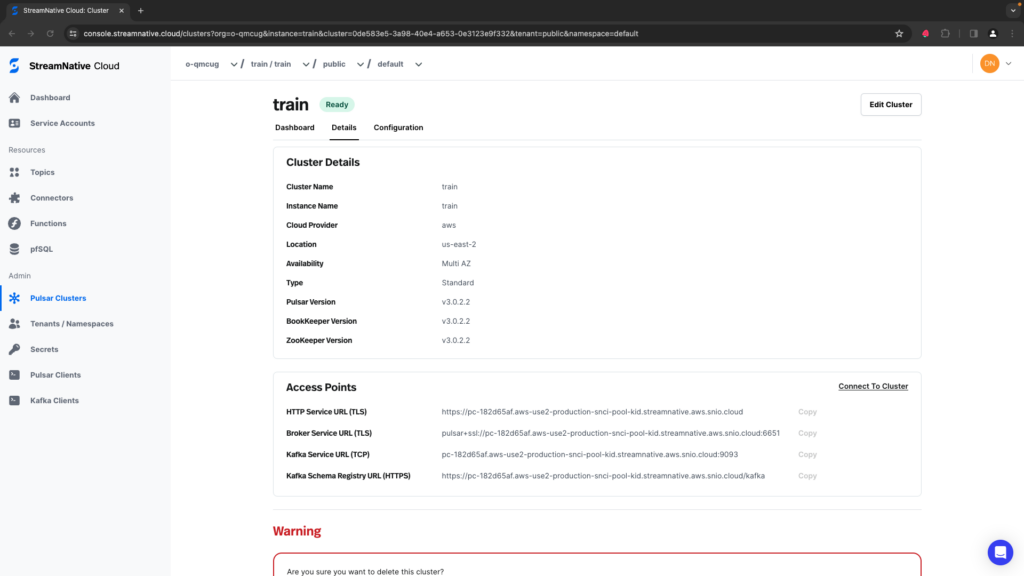
Broker Service URL (TLS) will be used by the Pulsar Client when producing and consuming messages to the Pulsar protocol handler. You can easily make changes to your cluster using the StreamNative UI, but the HTTP Service URL (TLS) Pulsar Admin endpoint is also available.
If you also plan on testing Kafka, you may need the Kafka Service URL (TCP) to produce and consume messages to the Kafka protocol handler. When you need to access the Kafka schema registry, you will use Kafka Schema Registry URL (HTTPS).
OAuth2
When configuring OAuth2 in the course code, you will need to adjust the audience to correspond to your org and instance. The audience should include the name of your instance (this is one level above the cluster, in the above image you can see both the instance and cluster are train at the top of the page). For example, the course instance is called train in an org called o-qmcug. The audience is therefore:
urn:sn:pulsar:<org name>:<instance name>
urn:sn:pulsar:o-qmcug:train
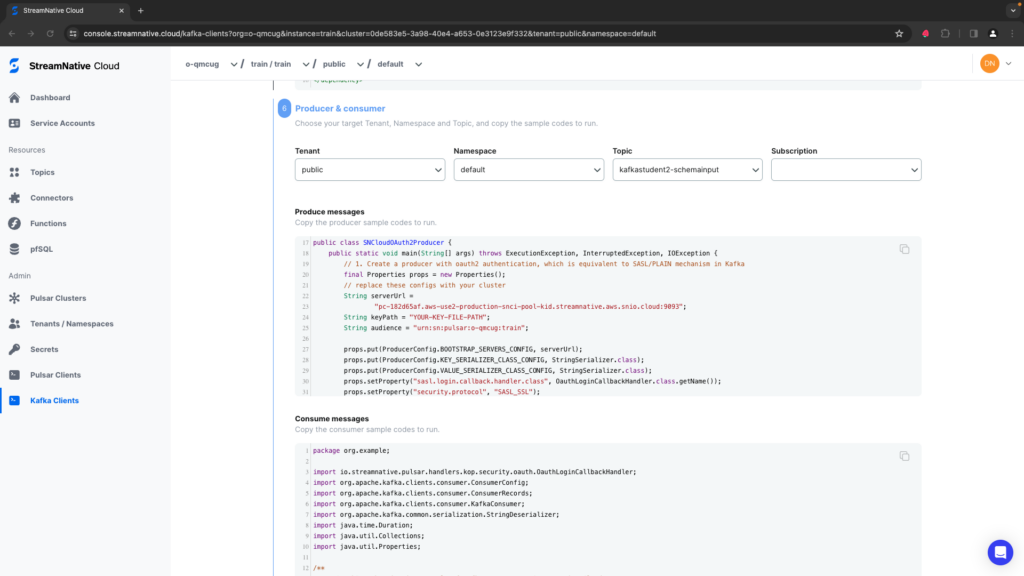
You can also verify you have the correct audience by clicking on Pulsar Clients or Kafka Clients in the left pane of the StreamNative UI. If you keep the default settings of Java Code libraries and click Next multiple times, you should see the Produce messages code where the audience for your cluster will be pre-populated.